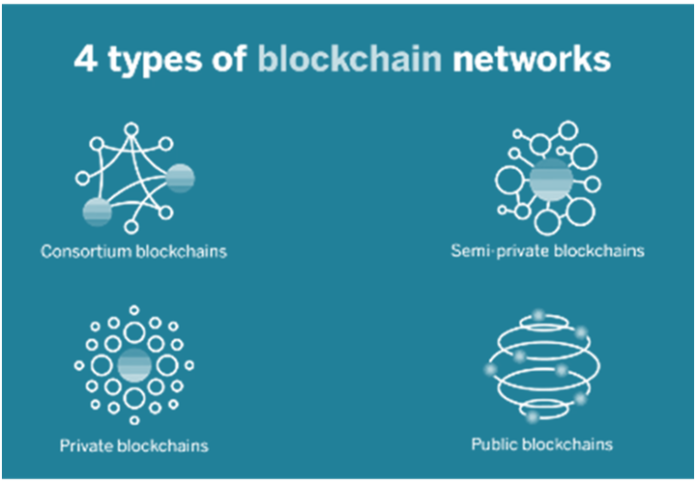


The decentralized nature of blockchain technology is well known for allowing for safe, transparent, and impenetrable data storage. By providing a new paradigm of trust and openness, this innovation has upended a number of industries, including healthcare and banking. But not all blockchains are created equal, and blockchain networks can be divided into many varieties based on the demands of the user and the application. We will examine each of the four primary categories of blockchain networks in this article: hybrid, private, consortium, and public. To properly use blockchain technology, it is essential to comprehend the distinct characteristics and use cases offered by each form of blockchain.
1. Blockchain Public
The most decentralized type of blockchain is a public blockchain, in which everyone can join the network as a node. This implies that everyone may sign up, watch transactions, and even participate in the consensus process by adding blocks and validating transactions. Because public blockchains are entirely open-source, everyone can examine and contribute to the code and architecture.
Important Features of Public Blockchains:
Decentralization: The network is not governed by a single entity. Instead, a large number of people (nodes) share authority and control.
Transparency: A public blockchain ensures transparency and builds confidence by making all transactions visible to the public.
Immutability: The blockchain ensures data integrity by making it nearly impossible to change data after it has been added.
Consensus procedures: To validate transactions, public blockchains generally employ Proof of Work (PoW) or Proof of Stake (PoS) as consensus procedures.
For instance:
The initial public blockchain, known as Bitcoin, was created to enable peer-to-peer transactions devoid of middlemen.
Ethereum: A public blockchain that makes it possible to create and run decentralized apps (DApps) and smart contracts.
The bitcoin industry and applications where decentralization, trust, and openness are essential are where public blockchains are most frequently utilized. However, they frequently have high energy consumption and scalability issues, especially with PoW-based systems.
2. Blockchain Private
A private blockchain is a network that is closed and permissioned, meaning that only a particular set of users can access it. Private blockchains are managed centrally by one or a small number of entities, as opposed to public blockchains. This implies that the public cannot see or take part in the blockchain’s operations, and that only authorized users are able to validate transactions.
Important Features of Private Blockchains:
Centralized Control: One group or consortium usually controls private blockchains, giving them the authority to decide who is permitted to use them and verify transactions.
Restricted Access: The blockchain is more private and secret since only authorized users are permitted to join the network.
Faster Transactions: Private blockchains typically offer faster transaction speeds than public blockchains since there are fewer and more regulated validators.
Low Cost: Private blockchains can be more economical to run since they do not require intricate consensus techniques like PoW.
For instance:
Hyperledger Fabric: A permissioned blockchain that businesses use to create private networks for safe data sharing and the implementation of smart contracts.
Financial institutions use Ripple’s (XRP) private blockchain to make quick and inexpensive international payments.
Businesses that need safe, private transactions and need to keep control over network participation may find private blockchains especially useful. They are frequently employed in sectors where data secrecy is crucial, such as banking, supply chain management, and healthcare.
3. Blockchain Consortium
A consortium blockchain, also known as a federated blockchain, is a type of hybrid blockchain that blends elements of private and public blockchains. Instead of being run by a single business, a consortium blockchain is run by a collection of pre-selected, reliable entities, like a group of banks. Consortium blockchains provide greater decentralization and dispersed control, even if they share some traits with private blockchains.
Important Features of Blockchains in Consortiums:
Shared Control: Instead than being under the sole authority of one organization or entity, governance is divided among multiple organizations or bodies.
Semi-Decentralized: Consortium blockchains are independent of a single authority, in contrast to private blockchains. Rather, transactions are managed and validated by the involved members working together.
Enhanced Transparency: Despite being permissioned, consortium blockchains allow consortium members to see transactions, which increases transparency among reliable players.
Efficiency: Consortium blockchains can achieve high transaction speeds and scalability while preserving security because they have fewer validators than public blockchains.
For instance:
R3 Corda is a consortium-based blockchain that is mostly utilized in the banking sector to speed up contract management and enable safe transactions.
Energy Web Foundation: An energy-related blockchain platform where a group of energy providers and consumers work together to increase the energy markets’ efficiency and transparency.
For sectors like finance, supply chain, and energy where several reliable organizations need to collaborate, consortium blockchains are perfect. They are a well-liked option for companies looking to securely interact since they provide the advantages of decentralization without the hassle and complexity of public blockchains.
4. Blockchain Hybrid
A hybrid blockchain combines elements of public and private blockchains. By permitting some data to be kept private while allowing other data to be made public, hybrid blockchains allow businesses to take advantage of the advantages of both models. A hybrid blockchain allows for greater flexibility and control over the management of data by allowing some parts of the blockchain network to be decentralized while keeping others controlled.
Important Features of Hybrid Blockchains:
Selective Transparency: In a hybrid blockchain, certain transactions or data are accessible to the general public while others are kept secret.
Customization: Businesses can alter the blockchain to meet their unique requirements by deciding which parts of the network are accessible to the general public and which are not.
Controlled Permissions: In order to strike a balance between decentralization and privacy, hybrid blockchains usually let businesses set up permissioned nodes while preserving public access to specific data.
Interoperability: By interacting with other blockchain networks, hybrid blockchains enable more scalability and flexibility in cross-chain transactions.
For instance:
Dragonchain is a hybrid blockchain that was first created by Disney that enables companies to use both public and private networks to accomplish various objectives, including scalability and secrecy.
Food sector participants can track and share information about food supply chains in a transparent and safe way with IBM Food Trust, a hybrid blockchain solution.
For businesses who require flexibility and customisation in their blockchain network, hybrid blockchains provide a potent option. They are frequently employed in sectors where privacy and transparency are critical, such as supply chain management, healthcare, and finance.
In conclusion
As blockchain technology develops further, new kinds of networks are appearing to meet the various demands of users, companies, and sectors. Although the public blockchain has decentralization, transparency, and immutability, it may have problems with energy consumption and scalability. Private blockchains are perfect for enterprise application because they offer centralized control, confidentiality, and faster transaction rates. While hybrid blockchains offer adaptable solutions that enable selective transparency and improved interoperability, consortium blockchains integrate aspects of both, providing shared governance among trusted institutions.
The degree of decentralization needed, the type of data, the number of participants, and the particular use case all play a role in selecting the best blockchain network. Understanding the various kinds of blockchain networks and their unique benefits and drawbacks will help firms make wise decisions and fully utilize blockchain technology as its adoption spreads across industries.