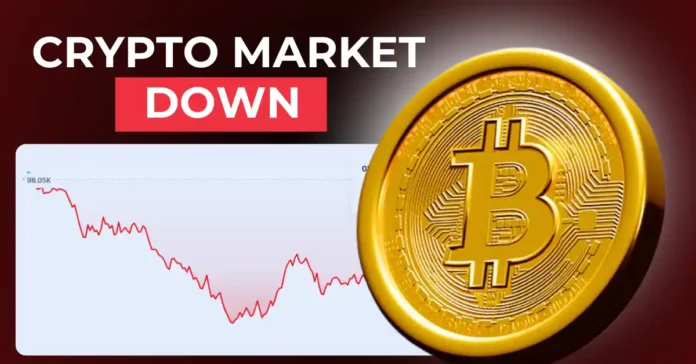


The notoriously volatile cryptocurrency market has seen yet another sharp decline, which has traders, investors, and enthusiasts alarmed. Major cryptocurrencies like Bitcoin, Ethereum, and a variety of altcoins have seen significant drops in value in recent weeks. This essay explores the causes of the recent decline in the cryptocurrency market, its implications for the future of virtual currencies, and the best course of action for investors.
1. Current Market Declines and Trends
Recently, the cryptocurrency market, which has frequently been linked to sharp price swings, has begun to decline. The price of popular cryptocurrencies like Ethereum (ETH), Bitcoin (BTC), and others has dropped dramatically. For instance, Bitcoin has dropped more than 50% from its peak in recent weeks, trading below the $30,000 mark after hovering near its all-time high of $60,000+ in late 2021.
Bitcoin is not the only cryptocurrency seeing this decrease. Similar losses have been incurred by Ethereum, the second-largest cryptocurrency by market capitalization, with numerous altcoins and DeFi tokens seeing even more severe declines. The market is currently in a downward trend, and investors are trying to figure out why and if this is a short-term correction or a long-term bearish trend.
2. Macroeconomic Elements Affecting Cryptocurrency Prices
The current decline in the cryptocurrency market can be attributed to a number of macroeconomic issues. The state of the world economy, especially the rising interest rates, is one of the most important. Interest rates have been raised by central banks worldwide, including the Federal Reserve in the United States, in an attempt to curb inflation. Investors may become less interested in riskier assets like cryptocurrencies as a result of higher interest rates, which often lead to reduced liquidity and higher borrowing costs.
Furthermore, many investors have become more cautious due to the persistent uncertainty in the global economy, which includes worries about oil prices, inflation, and geopolitical tensions. Cryptocurrencies are sometimes more severely impacted during uncertain economic times since they are regarded as speculative and volatile assets.
3. Pressure from Regulations on Cryptocurrencies
Another important issue contributing to the decline of the cryptocurrency sector is regulation. The use and trading of cryptocurrencies are subject to more stringent laws in a number of nations, including China and India. The U.S. Securities and Exchange Commission (SEC) and other regulatory agencies have recently increased their vigilance in examining the cryptocurrency market, especially with regard to the classification of cryptocurrencies and their compliance with trading regulations.
Because many investors are concerned about the possibility of restrictive regulations, higher compliance costs, or even outright bans in some countries, the specter of more regulation breeds some degree of uncertainty. Concerns over the cryptocurrency market’s long-term sustainability have arisen as a result of this legislative ambiguity, particularly with regard to projects and tokens that might not adhere to legal requirements.
4. Investor Fear and Crypto Market Sentiment
Sentiment has a significant impact on cryptocurrency markets, and during periods of collapse, investor anxiety frequently spreads swiftly. In the cryptocurrency world, the term “fear, uncertainty, and doubt” (FUD) is commonly used to characterize how bad news can lead to significant sell-offs. A domino effect occurs when the prices of Bitcoin and Ethereum decline, causing investors to panic and sell their holdings in an effort to reduce losses.
A market correction brought on by the prospect of more losses might result in more price drops, starting a vicious cycle. One of the primary causes of cryptocurrencies’ reputation as high-risk investments is their volatility. Investor sentiment is still shaky as they process the news of the dip and the possibility of additional price declines, which might extend the current trend.
5. Margin calls and liquidations
Significant market liquidations have also resulted from the current drop in bitcoin prices. The cryptocurrency market has seen a lot of traders using margin trading, which enables them to borrow money to trade larger amounts. Those who have taken on excessive leverage may be subject to margin calls, in which case they will have to liquidate their assets in order to pay back the money they borrowed, when the price of cryptocurrencies drops precipitously.
One significant sell-off may trigger further liquidations and drive prices even lower, so these forced liquidations may have a snowball effect. This tendency, which is especially prevalent in extremely volatile markets like cryptocurrencies, feeds the flames during market corrections.
6. Stablecoins’ Contribution to the Decline
The purpose of stablecoins, which are based on established currencies like the US dollar, is to preserve price stability. However, even stablecoins have seen difficulties during the latest downturn. When the well-known algorithmic stablecoin TerraUSD (UST) crashed earlier this year, investor trust was severely damaged. The whole cryptocurrency market was rocked by the collapse of UST and its companion coin, LUNA, which exacerbated the market’s pessimism.
Concerns regarding the general stability of the cryptocurrency market are raised by TerraUSD’s failure, which also draws attention to possible hazards inside the stablecoin ecosystem. The demise of UST has compelled regulatory organizations to examine stablecoin regulation and whether they are adequately supported by assets to preserve their peg, as investors may grow cautious about depending on certain stablecoins.
7. Network Upgrades and Technical Problems
Significant technological advancements are being made to cryptocurrencies like Ethereum, which may cause brief network outages or changes in market expectations. Delays and difficulties have plagued Ethereum’s continuous shift to Ethereum 2.0, which seeks to switch the network from a proof-of-work (PoW) to a proof-of-stake (PoS) consensus mechanism.
Even though these modifications are frequently viewed as long-term benefits for the network, short-term concern regarding their success might cause market volatility. Unexpected technical problems that could undermine investor confidence and fuel market declines are a constant concern as Ethereum and other blockchain projects develop.
8. Effects of Speculation and Media Coverage
Public view of cryptocurrency is greatly influenced by media coverage. Reports of significant price declines and unfavorable media coverage have affected investor sentiment during the current market collapse. News organizations frequently draw attention to the most dramatic elements of price falls, which makes institutional and ordinary investors feel panicked.
Furthermore, speculative hype cycles have been a problem in the cryptocurrency field, as price projections frequently lead to investments devoid of solid foundations. The market is forced to face the reality of overpriced assets when the speculative bubble collapses and prices begin to decline. The market’s intrinsic volatility is increased by its speculative nature, which also causes significant swings in the value of digital currencies.
9. The Effect of Institutional Participation
Although institutional participation in bitcoin markets has increased recently, the decline emphasizes how brittle this participation is. Due of the potential for large returns, a large number of institutional investors, including family offices and hedge funds, have entered the cryptocurrency market. These organizations may, however, sell off sizable holdings during downturns to shield their portfolios from more losses because they are also extremely vulnerable to market swings.
Since institutional investors are frequently regarded as the market’s stabilizing power, their absence during market corrections may make the decline worse. When they leave, the market becomes more susceptible to changes in prices caused by individual investors.
10. What Will Happen to the Crypto Market Next?
It’s challenging to forecast the precise course of the cryptocurrency industry in the future. The Bitcoin market has proven resilient in the past, recovering from prior crashes, even though the current dip has presented difficulties. According to some analysts, following the market’s explosive expansion in 2020 and 2021, prices are now leveling off during a period of market consolidation.
A number of variables, including as the clarity of regulations, technological developments, and widespread acceptance, will affect the long-term prospects of cryptocurrencies. Before making an investment, investors should thoroughly assess their risk tolerance and be ready for volatility. Long-term investors may find chances in the crypto market’s decline, but short-term traders need to be aware of the risks involved.
11. Final Thoughts: Handling the Recession
The risks and difficulties associated with investing in this erratic industry have been brought to light by the recent decline in the bitcoin market. The foundations of blockchain technology and the ongoing drive for financial decentralization are still solid, despite the uncertain short-term forecast. Navigating the downturn as an investor requires a grasp of the fundamental causes of the market’s volatility.
Long-term investors might see the current state of the market as a chance to buy, while others might decide to hold off on making an investment until things are more stable. Whatever the strategy, it is evident that even if the cryptocurrency market is now down, it is still a vibrant, constantly changing area with enormous development potential.