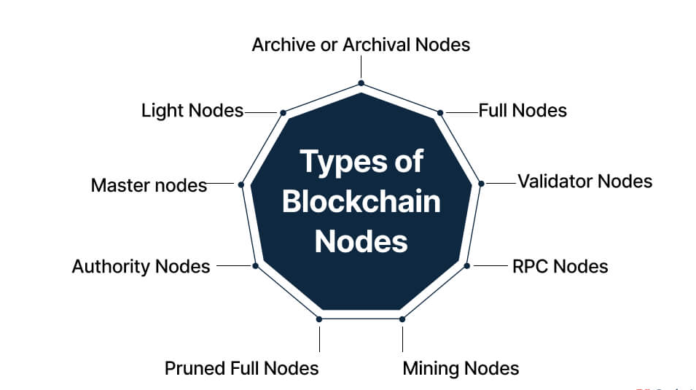


A node is a vital part of the network in blockchain technology. Individual computers or devices known as nodes are responsible for storing, sending, and validating transactions on the blockchain. They are in charge of upholding the decentralized aspect of the blockchain, making sure it is secure, and taking part in its consensus processes. Blockchain nodes come in several varieties, and each one has a distinct function inside the network.
The primary kinds of blockchain nodes, their functions, and how they support a blockchain network’s general operation will all be covered in this article.
1. Complete Nodes
One kind of node that keeps a full copy of the blockchain is called a full node. Complete nodes are crucial to preserving the blockchain’s decentralization and integrity. They make sure that every transaction conforms with the protocol regulations by validating blocks and transactions. Full nodes individually validate and authenticate the data, rather than solely depending on outside sources for transaction verification.
Important Features of Complete Nodes:
Whole Blockchain Copy: Full nodes are able to validate every transaction since they keep a record of every transaction on the blockchain.
Validation: Complete nodes make certain that each transaction conforms with the consensus rules of the network (e.g., confirming if transactions are legitimate).
Security: By ensuring that no erroneous or fraudulent blocks are appended to the blockchain, full nodes help to ensure the network’s security.
Decentralization: Full nodes, which do not depend on central authority or other entities to validate data, are essential for sustaining a decentralized network because anybody can operate them.
For instance, the complete nodes of Bitcoin, Ethereum, and other well-known cryptocurrencies guarantee the integrity of their own blockchains.
Because the complete blockchain needs to be downloaded and maintained, operating a full node demands a large amount of storage, computing power, and bandwidth. Full nodes might not be appropriate for users with little processing power, even though they are necessary for blockchain security and decentralization.
2. SPV Nodes, or Light Nodes
A lighter variant of a full node is called a Light Node, sometimes known as a Simplified Payment Verification (SPV) Node. Light nodes do not hold the complete blockchain, in contrast to full nodes. Rather, all they download are the block headers, which include block metadata like the timestamp, the hash of the preceding block, and the Merkle root of the transactions in the block.
For light nodes to obtain the required transaction data, complete nodes are required. They are frequently utilized in applications where storage and bandwidth constraints are an issue, such as mobile wallets.
Essential Features of Light Nodes:
Partial Blockchain Copy: Light nodes don’t store the entire blockchain history; they just save block headers.
Dependency on Full Nodes: Since light nodes are unable to independently validate every transaction, they rely on full nodes to supply comprehensive transaction data.
Faster Synchronization: Because light nodes simply download the block headers and not the full blockchain, they sync considerably faster than full nodes.
Low Resource Requirements: Light nodes use significantly less storage and processing power because they only store a small amount of data.
Examples: Light nodes are frequently used in mobile cryptocurrency wallets (like those for Ethereum or Bitcoin) to enable faster access to the blockchain without requiring a lot of data storage.
The capacity to properly verify transactions is sacrificed by light nodes, which depend on full nodes for accurate information even though they are more simpler to operate due to their low resource requirements.
3. Nodes of Miners
Nodes that take part in mining, which entails approving new transactions and adding them to the blockchain, are known as miner nodes or mining nodes. Miner nodes compete to solve challenging mathematical puzzles in Proof of Work (PoW) blockchains, like Bitcoin, in order to get rewards in the form of cryptocurrency.
Miner nodes are a specific subset of full nodes that actively contribute to the block building process in addition to validating and storing transactions. By suggesting new blocks to be added to the blockchain, they support the network.
Important Features of Miner Nodes:
Transaction Validation: Similar to full nodes, miner nodes check and validate transactions.
Block Creation: New transaction blocks are suggested and produced by miner nodes and subsequently appended to the network.
Proof of Work: To obtain a valid hash for a new block, miner nodes compete with one another to solve cryptographic challenges in PoW blockchains.
Incentives: In exchange for their efforts in network validation and security, miner nodes receive transaction fees and freshly created bitcoin.
Miners of Ethereum (albeit Ethereum is moving to Proof of Stake), Bitcoin, and other PoW-based networks are a few examples.
Because mining entails solving cryptographic riddles, which call for powerful hardware, miner nodes need a lot of processing power. The computational difficulty, electricity costs, and the cryptocurrency’s current value all affect how profitable mining is.
4. Staking Nodes, or Validator Nodes
Proof of Stake (PoS) and other consensus methods, such as Delegated Proof of Stake (DPoS), employ validator nodes. Similar to miners in PoW blockchains, validator nodes in PoS-based blockchains are in charge of verifying transactions and generating new blocks; however, they are chosen based on the quantity of cryptocurrency they have staked (locked up as collateral) rather than their ability to solve cryptographic puzzles.
In PoS blockchains, validator nodes rely on a participant’s stake—the quantity of bitcoin they own and are prepared to lock up as collateral—to make sure they behave honorably, in contrast to miner nodes, which demand a significant amount of processing power. A validator node may lose the cryptocurrency they have staked if they are shown to be dishonest.
Important Features of Validator Nodes:
Proof of Stake: The quantity of cryptocurrency that validators have staked in the network determines which ones are chosen.
Block Creation and Validation: Validator nodes are in charge of both generating new blocks of transactions and validating existing ones.
Staking: To guarantee that they behave in the network’s best interests, a node operator must lock up a specific quantity of cryptocurrency in the network as collateral in order to become a validator.
Reduced Need for Resources: Validator nodes are more energy-efficient than miner nodes because they don’t need as much processing power.
Examples of PoS consensus systems that involve validator nodes include Cardano, Tezos, Polkadot, and Ethereum (after it switched to Ethereum 2.0).
For people who wish to contribute to blockchain network security without needing the processing power of mining, validator nodes are perfect. They do, however, run the danger of losing the bitcoin they have staked if they behave maliciously or improperly validate transactions.
5. Nodes in Archives
Archival Nodes are complete nodes that hold extra information about previous transactions in addition to the blockchain’s whole history. This kind of node stores additional information that conventional full nodes might not, like historical blockchain states and details about previous blocks.
Applications and services that need access to historical blockchain data, such explorers, data analytics tools, or decentralized applications (DApps) that need to make reference to previous blockchain states, depend on archival nodes.
Important Features of Archival Nodes:
Whole Blockchain History: Archival nodes keep track of all previous data and states in addition to the blockchain’s current state.
High Storage Requirements: Archival nodes need a lot more storage space than full nodes due to the large amount of data they hold.
Blockchain Analytics: Companies or research organizations that need to access blockchain data from any time in its history frequently utilize archival nodes.
For instance, archival nodes are used by blockchain explorers such as Etherscan to give users access to historical information and previous transactions.
Although archival nodes are crucial for anyone who seek in-depth access to blockchain data, institutions or blockchain services usually employ them instead of ordinary users because of their high storage needs.
In conclusion
Nodes are the fundamental units of the blockchain that guarantee the network’s decentralization, integrity, and security. From preserving the entire blockchain history to validating and producing new blocks, different kinds of nodes have different functions.
By independently verifying transactions, full nodes guarantee the blockchain’s decentralization and security.
For users with limited resources, Light Nodes (SPV Nodes) provide a lightweight alternative that sacrifices complete validation in favor of speed and effectiveness.
In Proof of Work blockchains, miner nodes use their processing power to add new blocks and validate existing ones.
As an energy-efficient substitute for mining, validator nodes work in Proof of Stake networks, verifying transactions according to the quantity of cryptocurrency staked.
Archival Nodes serve applications that need deep blockchain analytics by storing a blockchain’s complete history, including previous states and historical data.
You can navigate the blockchain ecosystem more effectively if you are aware of the crucial functions that each type of node plays in maintaining the security and seamless operation of blockchain networks.